Friday, May 11, 2012

Cigar shopping in Cyprus

Last week I went on vacation to Cyprus and since I heard that the Casa del Habano in Nicosia (which is the capital and named Lefkosia in greek) had good prices on cigars and a good selection, I decided to check it out.


I didn't take a picture of the upstairs humidor.


So here's what I bought :

H. UPMANN HALF CORONA SUB JUN 11


BOLIVAR RE 2009 GRECIA Y CHYPRE
PARTAGAS SALOMONES 2008


H. UPMANN ROYAL CORONAS EOG AGO 00


MONTECRISTO PURITOS


HOYO DE MONTERREY PETIT ROBUSTOS


ROMEO Y JULIETA PETIT CORONAS


H. UPMANN MINI


H. UPMANN PURITOS


PARTAGAS CORONAS SENIOR


HOYO DE MONTERREY CORONATION
ROMEO Y JULIETA ROMEO No 1
PARTAGAS PARTAGAS DE LUXE


MY BEST PURCHASE : HOYO DE MONTERREY HOYO DES DIEUX MPC NOV 03


I also visited the duty free cigar shop in the Charles-de-Gaulle airport on my way to Cyprus and pick up a box of French REs:


PUNCH SMALL CLUB RE FRANCIA TGU AGO 09


THERE YOU HAVE IT !

Saturday, January 7, 2012

Next generation of cigars beads

This is a new kind of silica cigar beads that will soon be for sale on eBay.


Cigorange humidifier beads© (silica gel cigar beads)


Why pay more for lesser quality and potentially dangerous beads ?
Cigorange humidifier beads© are made with pure amorphous silica and a safe activating coloring agent that turns from orange to dark green as the humidity level rises. No more guessing the humidity level of your humidor or when to add distilled water. Just by looking at your Cigorange beads you will know when to add water: when they start returning to orange, it's time to add water.


Lesser quality blue activating coloring beads contain cobalt chloride, which has recently been discovered to possibly cause cancer by inhalation. Why risk your health with anything but Cigorange humidifier beads© ?
Cigorange humidifier beads© are the same silica gel beads that have been used with confidence for many years by specialized industries in medical, electronic, optical and communication instruments and devices. They are now available for the first time to cigar enthusiasts to help maintain and protect their precious collections.

No more fiddling with propylene glycol solutions, gel humidifier jars or humidifier pads and the constant additional costs of maintaining them.
With Cigorange humidifier beads©, an occasional addition of distilled water is all you need to keep your humidor’s RH. They’ll last for years !
All you have to do is place your Cigorange humidifier beads© in a shallow dish or in a fine mesh bag and spray around 70% of the beads with distilled water and you’re good to go !
(adding anything else than distilled water to your beads will ruin them)

Cigorange humidifier beads© are available in ½ pound and 1 pound bags.
½ pound will regulate up to 2.5 cubic feet (4320 cu. in.) of volume
1 pound will regulate up to 5.0 cubic feet (8640 cu. in.) of volume

We suggest using double the amount of beads needed for the size of your humidor, for added stability and a quicker return to optimal humidity after your humidor has been opened.
Cigorange humidifier beads© use the same technology as museums do to preserve precious artifacts.
Every cigar smoker knows that a constant and proper humidification is crucial for the storing and aging of cigars. Improper humidity can lead to mold problems and/or draw and burn issues.

The Cigorange humidifier beads© will start to work as soon as you put them in your humidor.

Is your RH too high ? Cigorange humidifier beads© will adjust it.

Is your RH too low ? Cigorange humidifier beads© will adjust it.

Once your preferred RH is reached, the Cigorange humidifier beads© will constantly regulate and maintain it. Simple and effective.

The Cigorange humidifier beads© will BOTH absorb AND release moisture to help maintain a constant  level of humidity. They will last many years,  and do not use messy or costly propylene glycol solutions. They are VERY low maintenance.

Simply add a little distilled water and let the technology do the rest! When the Cigorange humidifier beads© begin to turn from green to orange*, all you have to do is add a little distilled water.

What could be more effective and simple?
* : the color of your beads will depend on the RH you decide to maintain.

What is included with your purchase :
-       Cigorange humidifier beads©
-       Instructions

Thursday, December 29, 2011

Cigar aging experiment - first tasting

I waited a long time for an occasion to smoke one of my experimental cigars by no fault of mine (almost), with winter in Canada making it difficult to find a place and time to smoke.


First off, here's a pic of all ten experimental cigars. The original 8 as in my original post and 2 more sent to me graciously by SeeGar from the the CA forum, which have been naturally aged.


Just as a reminder :


Cigars 1-2 : high temperature, low humidity
Cigars 3-4 : one month in the freezer at -17.9°C/0°F
Cigars 5-6 : MSG added
Cigars 7-8 : control group, left in my main humidor with the remaining cigars of that box
Cigars 9-10 : aged cigars


So of course, which cigar did I pick to start the second phase of the experiment ?


#5 full of MSG goodness ! Or as others would say, full of &#@$?% ...


As you can see in the picture on cigars 5 and 6, a part of the MSG that the wrapper was exposed to did form a kind of salty residue once the solution evaporated. When putting the cigar to my lips, it gave off a kind of salty/meaty taste, almost the same as tasting MSG directly from the jar.


I used a punch cutter and tested the cold draw : deep tobacco flavor that was very pleasing, the kind of cold draw aroma you get when you know you're in for something special.


I lit the cigar with my trusty 7$ Ronson torch lighter and started slowly puffing away. Right away it was very noticeable that it was a different taste compared to the regular Cremas I've smoked before.


It tasted the same as the cold draw, deep, satisfying tobacco with no bitterness. In the first 1/4 to 1/2 inch, I'd say it was medium/full. As I continued to smoke, the intensity of flavour went to very full and stayed like that up to the half way point or so. After that it went back down to medium/full and then medium, though it stayed a little bit stronger than a "unmodified" Crema. The fullness of flavor reminded me of a good non-cuban cigar, but with cuban flavour. I haven't smoked all the "popular/classic" cubans yet, but I've smoked enough of them to say that it was as strong or stronger than a great majority of them. As for the aroma of the cigar, it stayed pretty much the same all the way through to the end, no change there, as a Crema doesn't have a rainbow of flavours to begin with. It still remains the best cheap and cheerful cuban cigar for me (I do like all Jose L. Piedra's, but the Crema is my favorite)


For the draw/burn/smoke characteristics, the draw was spot on (though I'm pretty sure the MSG had no impact on that), the burn was very good (I didn't have to relight or do some touch ups) and the amount of smoke was very good. I don't think the MSG had something to do with the amount of smoke, but it seemed to me that there was more of it than usual.


 As I was thinking about that cigar today, I was wondering why the surge in intensity after half an inch or so and then less of it. Usually in a cigar, when the strength builds up the more you smoke it, it never goes down, to the point that pretty often you have to stop smoking it because it's too strong and/or bitter. Than I remembered how I applied the MSG : a little bit all over the wrapper and a lot in the first third or so with the syringe. So when the burn line reached the MSG inside the cigar, the intensity of flavour went up and when it passed it, the flavour went down. So I guess the MSG has a real impact on the tobacco or more precisely on the way we perceive it as it heightens the sensitivity of taste buds and/or olfactory receptors.


So the mellower, more refined taste of an aged cigar (if I can describe it like that) wasn't there at all, quite the contrary. It was more like a Crema on steroids, but still very good. I'd say that the MSG improved somewhat what a Crema is, regarless of strength, but not much. But if you go for a stronger cigar, than the addition of MSG is something to consider, because I would smoke that cigar again since it was pretty good !


Now would I or will I try again to add MSG to different cigars to improve on the fullness of flavour, meaning the deepness of the aromas and overall strength ? I don't think so. I'd rather just buy a more flavorful cigar if that's what I'm looking for instead of adding something to one. It's not because I don't want to add a nasty chemical to my cigars, as MSG is naturally occuring in a lot of food we eat, I just want to taste the cigar in it's natural state.


So what about the freezing or heat treatment I've done to other test cigars, would I do that again if it turns out that it's something wothwhile doing ? Yes I would as it's just changing what's already there. 


I still have one other MSG modified cigar to smoke, but that one will be smoked in the double blind part of the experiment. I will have however to clean off the MSG residue on the wrapper so I can't recognize it.


So that's all for now, I'll try post an update as soon as I can.


In the mean time, HAPPY NEW YEAR TO ALL OF YOU !!!

Wednesday, November 23, 2011

Cigar repair glue alternatives

So what's more sad than reaching into your humidor for that special cigar you've been saving all that time and to find that the wrapper has a tear or is loose. Fear not, cigar glue to the rescue.


A glue that's well known is the El Torcedore or El Jimador from Credo. It's a small 5 ml bottle that's looks a lot like a bottle of fingernail varnish, mini brush in handle and all. It's around 10$.


 You can also buy some wrap glue that's used to make your own tobaco or other plant material cigarettes.
Here are some brand names : Juicy rolling glue, Tasty Puff wrap glue(1/4 oz bottle), Kingpin cigar glue...


They are all made with combinaisons of the same base ingredients(water, propylene glycol, gum acacia and flavoring if any). You can even make your own by mixing these ingredients, after buying some gum arabic on the web or eBay :


Description of the eBay item : Gum Arabic 2 oz NEW
When Gum Arabic is mixed with varying amounts of water, it can be used as a glaze for marzipan, or an edible glue for gum paste. Used as a glaze it gives the decoration a glossy sheen. Gum Arabic is an ingredient used in all kinds of confectionery recipes such as gummy type candies and chocolate candies. Certified Kosher


Or can do what I did with a little research. I went to an arts and cratfs store (DeSerres) and bought a big bottle of gum arabic. It was 11.99$ for 75 ml, instead of the 10$ or so for the 5 ml of the El Torcedore, quite a good deal in my book.


Now, you might ask yourself, what is gum arabic or gum acacia ?
Here's some info :


Though many believe that gum is primarily used for chewing, it has many other viable uses. Gum arabic is a type of gum that is used in everything from a food stabilizer to inks and textiles. It comes from the hardened sap of the Acacia Senegal and the Acacia Seyal trees.
Also called chaar gund, gum acacia, meska, or char goond, this natural gum is usually free of color, odor, and taste. When the sap seeps from the tree and hits the air, it often hardens to form an oval the size of a pigeon's egg. It can almost be fully dissolved in its own volume of water. When sold alone, it can be in the form of syrup, powder, oil, chunks, or pellets.
Sap is grown for commercial use in Sudan, Somalia, Senegal, Arabia, Egypt, West Asia, and other countries. The sub-Saharan region has been given the moniker "the gum belt" for its high volume of gum arabic harvested. Sap trappers stimulate its flow by carefully stripping pieces of the bark once a year without injuring the tree. They are then able to extract the sap for approximately five weeks per year, ten years per tree.
The gum's chemical components of glycoproteins and polysaccarides, which give it the consistency of glue, are what make it a good stabilizer for food. Like gelatin and carrageenan, gum arabic can be used to bind food substances as well as to smoothen textures, or to hold flavoring. The gum is used in soft drink syrups, chocolate candies, gummy candies, and marshmallows.
Gum arabic has many non-food uses as well. It is considered a vital component in traditional lithography, particularly when used in paints, inks, glues, and printing. Within the textile and pharmaceutical industries, gum arabic is sometimes used to control viscosity. It can also be used in cosmetics, photography, incense cones, shoe polish, postage stamps, cigarette paper adhesive, and pyrotechnic operations. The sap is also being researched for a potential role in intestinal dialysis.
Herodotus mentions the use of the sap during embalming procedures in the fifth century in Egypt. In the ninth century, it was described as useful for poultices or compresses for the eye. During the 12th century, gum arabic was used as an item of commerce. African farmers sell the gum in local markets as a health remedy. People use it to help with stomach and intestinal problems, sore throats, eye issues, bleeding, and the common cold.


So when you see torcedores use glue on the wrappers and caps, it's just gum arabic that's mixed with not much water so it has a very thick consistancy.


End of mystery !

Quai d'Orsay brand information

Just in case your interested in the origin of the brand : 


Cette saga française, née en 1973 sous l'impulsion de Valérie Giscard-d' Estaing, alors ministre de l'Économie et des finances entendait doter la France d'une marque prestigieuse produite à Cuba. Le patronyme de la marque ne doit rien au ministère des Affaires Étrangères, mais bien à feue la Seita (Société d'exploitation industrielle des tabacs et des allumettes), dont le siège social était situé sur la même rive de la Seine à Paris. Le projet, supervisé par le spécialiste du tabac Gilbert Belaubre, est réalisé par Cubatobaco à la manufacture Romeo Y Julieta. Conformément aux préférences françaises de l'époque, la cape est claire et la liga plutôt légère. Pourtant, le concept n'a jamais vraiment fasciné le consommateur français, fidèle aux marque historiques. Les Quai d'Orsay ont néanmoins bénéficié d'une campagne de relance à l'été 2005. À ce jour, elle est la seule marque de cigare étrangère fabriquée à Cuba.

Sunday, October 2, 2011

Cigar aging experiment

One thing that is at the heart of cigar collecting is to let your cigars age long enough for them to become great cigars. Or at least that's the hope...

The hard part is waiting ! Who wants to wait 5 years or more to start smoking a box you bought last week ? You waited a week and you're already going crazy thinking about how tasty those babies must be, but you're supposed to suppress that and wait patiently 259 more weeks ? It's inhumane.

For cigar aficionados that have a large collection of boxes, it's not a big problem usually because they almost always have some aged stuff to smoke while the new boxes are resting. But for the rest of us, there must be way around this problem.

I looked around the internet, spoked with a few BOTLs and managed to find a few clues. I'm going to share them with you. Now, don't judge to fast even if it sounds pretty weird, keep an opened mind, you might be suprised in the end. In the end, we just want better tasting cigars.


First, a little bit of basic facts about cigar storage/aging.

We all store our cigars in humidors and even if there's a wide variety of models, they all serve the same purpose: keep the cigars at certain humidity and temperature levels, usually 70%/(21.1°C/70°F). Rencently though, more and more of us now keep our cigars around 65% RH for better draw and long time aging with the added benefit of better mold prevention.

Now for the aging process: like many things on this earth, tobacco ages quicker with a rise in temperature, humidity and pressure. That's why during the manufacturing process of cigars, humid tobacco leaves are stacked together in big piles, wrapped in bundles and left to ferment in the natural heat of the producing country. Chemical reactions occur and flavors develop, changing the tobacco from harsh and bad tasting, to a smoother and better product worthy of being rolled into magic.

The same thing happens in a humidor, but at a much slower pace. Lower humidity and temperature levels are the reason why it takes so long for a finished cigar to age. Doing it any other way puts those precious sticks at risk of MOLD.


So what can we do ? Here's the three methods I found that might work:

- raise the temperature and lower RH
- freeze cigars for 1 month
- add MSG to cigars


RAISE THE TEMPERATURE AND LOWER RH

For mold to grow, it takes a certain humidity level and that's pretty it. The higher the temperature, the faster it grows, but it'll grow even if it's just a few degrees above 0°C/32°F. So the trick is to lower the RH to a point that even a warm environment doesn't allow mold growth.


FREEZE CIGARS FOR A MONTH

I got this info from a fellow forum member that a very well known cigar aficionado freezes his cigars for a month and says that it makes the cigars taste like they were aged for 4 years the regular way. That seems very counterintuitive, especially considering what I've written above. But like I asked of you in the beginning, I'll keep an opened mind... Considering the source of this information and if the messenger related it faithfully and didn't invent it himself to prank me or others, it's something worth trying.


ADD MSG TO CIGARS

Some people get afraid when they hear MSG, so here's something to erase those concerns: MSG is monosodium glutamate, the salt form of the amino acid glutamate, which has an important role in our body as the most abundant neurotransmitter in the central nervous system. A number of common food ingredients contain high levels of naturally-occurring free glutamate, including tomatoes and tomato juice, grapes and grape juice, other fruit juices, soy sauce, cheeses such as Parmesan and Roquefort and mushrooms. Our bodies even produce MSG, maternal milk contains ten times the level of MSG in cow's milk.

MSG has been used in food as a flavor enhancer, itself only tasting somewhat salty. It has been recently accepted that MSG triggers a special kind of taste buds called umami, which are considered to be the fifth basic taste perceived by the tongue, the other four being salty, sweet, sour and bitter.
It can be described as a pleasant "brothy" or "meaty" taste with a long lasting, mouthwatering and coating sensation over the tongue.  Its fundamental effect is the ability to balance taste and round the total flavor of a dish.

So what's all this have to do with cigars? It is believed that during the fermentation process of tobacco leaves, MSG is formed and that's what in part gives a deeper flavor to the tobacco. The longer the fermentation or curing of the tobacco, the more MSG there will be and so more flavorful cigars will be produced.

So a young cigar or one made with less cured tobacco will have less MSG and therefore less taste. So why not add MSG to cigars ? It would artificially age cigars almost instantly.

And where do you get MSG? At the grocery store of couse! It's in the same aisle as spices: one common brand is Accent.


So after all this, what's this experiment mentionned in this post's title anyway ???


I've decided to try all three methods and see if any of them work for real. So here's what I did:


Found 8 identical cigars (Jose L. Piedra Cremas) which I separated in 4 groups of 2:


Cigars 1-2 : high temperature, low humidity
Cigars 3-4 : one month in the freezer at -17.9°C/0°F
Cigars 5-6 : MSG added
Cigars 7-8 : control group, left in my main humidor with the remaining cigars of that box


Why did I choose these cigars? Because they're not very expensive and I didn't want to ruin my better cigars! And why 2 cigars for each method? Just to be a bit more sure of the results.


Here's a few pictures and some comments:


The three test groups

MSG from the grocery store, about 3$

100% MSG

1 gram of MSG that I diluted in 10ml of water, so 10% w/w ratio. Why that amount? I thought it tasted "salty" enough to have an effect...just a guess...

Ended up using 2ml of the solution, 1ml per cigar, which means 0.1 gram of MSG per cigar

I used 0.5ml to wet the outside of each cigar
Wrapped each cigar with plastic wrap for 1 minute
After 1 minute cigar 5
After 1 minute cigar 6
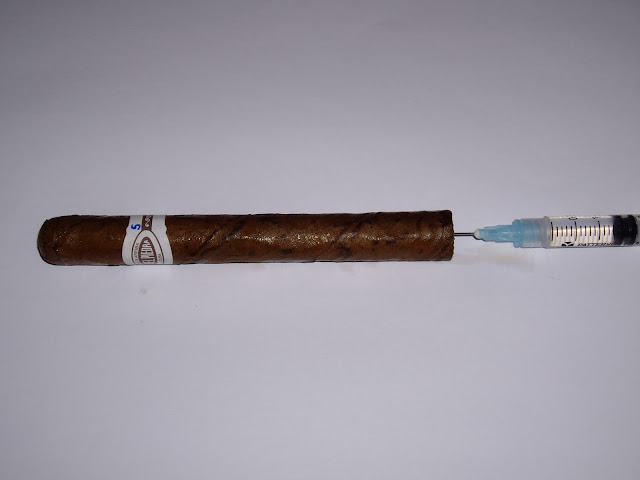
Injecting the remaining 0.5ml starting at a depth of 1,5" and pulling out while injecting
Cigars 1-2 in tubes that I sealed in a plastic bag before going in high temperature environment
Cigars 3-4 in plastic tubes that I sealed in a plastic bag before going in the freezer
Cigars 5-6 in a baggy with cigar beads to lower the RH before being returned to the humidor

High temperaure environment is an electric blanket that's setup  for our cats (!) which reaches a constant 109°F/42.8°C The starting RH is 62% for this test, as well as for the others.


So now comes the wait: I'll stop the experiment in a month, just because the freezer test takes 1 month and I don't want to wait more to find out the results, simple as that !


See you in a month !